

Weekend roundup: Our very necessary parts


For decades, the working assumption in medicine was that postmenopausal ovaries are basically inert.
Useless. Pointless.
Not too long ago, a well-known doctor, on a very big podcast, went so far to compare them to an “empty sac, flapping in the breeze”.
Then came new research out of Northwestern led by reproductive biologist Francesca Duncan, suggesting that’s wrong. Her team found that in old mice, the ovary doesn’t just shut down after its reproductive years end — it transforms. It fills with immune cells (T cells, macrophages, the kind of cells that show up when the body is remodeling tissue or managing inflammation) and appears to start sending immune signals out into the rest of the body. Duncan herself has said she used to think of the postmenopausal ovary the way most of us were taught to: like an appendix, a vestigial leftover. This data suggests it might instead be an active organ with a second career. We don’t yet know what that means for human health, but I hear hope in a chorus focused on chronic inflammation in the menopause years.
That’s not all! This has been burbling along for awhile to those who paid attention, including in several articles in the New York Times over the time span, but a Scientific American article earlier this month blew it wide open (again): the consensus that female mammals are born with all the eggs they are ever going to have? Yes, it turns out that recent decades have produced research that found humans and non-humans seem to be able to generate new ones. As per usual, people don’t like to have their dogma challenged: article author Starre Vartan writes “the findings are fueling a contentious debate in reproductive biology and raise a provocative, and controversial, possibility: ovarian aging may be far more dynamic than we thought – and perhaps even reversible”.
Then there’s the uterus. In 2019, researchers at Arizona State, funded by the National Institute on Aging, found that rats who had only their uterus removed — ovaries kept intact — performed measurably worse on spatial memory tasks than rats who kept everything, or who lost their ovaries too. The uterus, on its own, appeared to be performing a primary function for the brain.
Here’s my point: we built an entire medical framework around the idea that female reproductive organs stop mattering the moment they stop reproducing. Mainstream medicine does such a brisk business removing those organs, I’d argue that in a lot of spaces, including for Black women, they don’t matter as much as they should before that happens too.
Regardless, that framework is now crumbling. It really does seem that these organs have been quietly fulfilling quite-vital functions. I suspect we haven’t but skimmed surface of this topic, and I’m also excited to see what else they’ve been up to that we couldn’t have imagined.
CBT FOR SLEEP FTW – “Because only one third of nocturnal wakefulness during the menopausal transition is directly linked to hot flashes, VMS-targeted therapies alone are insufficient for many women with sleep disruption – and cognitive behavioral therapy for insomnia, supported by sleep society guidelines and accessible through free digital platforms, should be part of every clinician's sleep management toolkit.”
Contemporary Ob/gyn: Pauline Maki, PhD, on why CBT for insomnia is underused in menopause care despite strong evidence
🤰 PREGNANCY AS A PREVIEW – It’s starting to look like all pregnancy gives us a window into future disease, not just those that had problems. Rutgers researchers followed 1,225 pregnancies for about seven years using electronic health records and found that women’s cardiovascular health during pregnancy — not just whether they had gestational diabetes or preeclampsia — predicted how soon they’d later be diagnosed with chronic hypertension or metabolic conditions. Using a pregnancy-adapted version of the American Heart Association’s Life’s Essential 8 score (BMI, blood pressure, glucose, smoking, diet, activity, sleep), the team found that women with lower scores got diagnosed sooner, and the pattern held even among women who had zero pregnancy complications. Translation: the current system waits for a diagnosable complication like gestational diabetes before flagging someone as high-risk, but the risk signal may already be visible earlier, in the ordinary numbers collected at every prenatal visit.
This is an observational cohort study, not a trial of any intervention, and the researchers themselves flagged that they saw relatively few actual cardiovascular disease events, so those specific findings need to be read cautiously. What it does support is a broader, useful reframe — that cardiovascular risk isn’t a threshold you cross, it’s a continuum you’re on the whole time, and pregnancy is one of the few windows where women are in frequent enough contact with the healthcare system for anyone to notice.
🏃♀️ SUPER MOVERS FTW – A new study in Neurology looked at people 80 and older who walk unusually fast for their age — at least 1.5 standard deviations above the average for their age and sex, dubbed “super movers” — and found they had a 51% lower risk of cognitive impairment over 3–5 years, plus slower decline in memory, processing speed, and executive function. They also had greater volume in the right hippocampus, the brain region tied to memory. The twist: super movers didn’t actually have less Alzheimer’s-related pathology in their brains. They had the same amyloid plaques and tau tangles as everyone else, but were just apparently better at functioning despite it. The researchers frame this as evidence of “cognitive resilience” rather than being fleet-footed offering protection from the disease itself.
The study was observational, the neuroimaging sample was small, they didn’t account for genetic risk factors and it’s still very much up for debate whether fast gait is causing the resilience or is just the most visible marker of something else going on (better cardiovascular health, more physical activity over a lifetime, healthier aging generally, etc) that’s doing the actual work. The researchers themselves say that is the next step: figuring out whether being a super mover is “itself neuroprotective”.
⚠️ THE HIDDEN COST OF VIOLENCE – A review out of the University of Granada, published in Maturitas, pulls together the evidence on what surviving violence does to women’s bodies decades later. The authors call for trauma-informed menopause care to become the standard, something Paula Rastrick called for at the Hotflash inc Summit last year.
Women with a history of violence — intimate partner, sexual, or otherwise — tend to reach menopause up to 20 months earlier than women without that history, and report more severe hot flashes and night sweats, higher rates of depression, anxiety, PTSD and insomnia, more vaginal dryness and pain, and elevated long-term risk for hypertension, diabetes, metabolic syndrome, osteoporosis and cognitive issues. The proposed mechanism is chronic dysregulation of the stress axis (HPA axis) plus epigenetic changes from sustained trauma — basically, the body keeps the score long after the event is over, and menopause is where it gets exposed.
The study authors envision private consultations, proactive screening, and care pathways that connect gynecology with mental health and pelvic floor physio, and involve comprehesive screening to detect possible decades-old symptom drivers.

Quotable
“It’s almost cult-like, this idea that everybody must have HRT.”
– Paula Briggs, a former chair of the British Menopause Society who currently leads the menopause service at Liverpool Women’s Hospital, to The Checkup, MIT Technology Review’s weekly newsletter.
🔥 The Hot Truth About Hormone Therapy is a clear + comprehensive guide to understanding the entire landscape of prescribing approaches – at least 12 – along with all the gaps and inconsistencies and the things that just don’t make sense. All steeped int Hotflash inc secret sauce of journalistic discernment based on scientific evidence, expert opinion and human experience. Empower yourself or the women you serve, or both, in making a very important health decision. And the best part? Unlike a book, it’s now a living, breathing document, with a bullet list of updates sent right to your inbox as long as I’m doing this.
📚 BOOKSBOOKSBOOKS 🌍
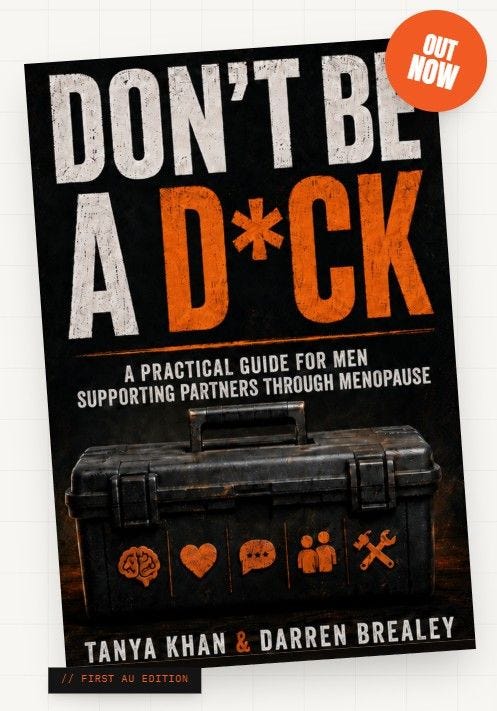
Australia: Don't Be A D*ck, a new guide for men, is co-authored by Melbourne-based lawyer and certified perimenopause and menopause coach Tanya Khan, and award-winning playwright and author Darren Brealey. As Khan rightly points out: “Despite the scale of the issue, there are almost no resources for men.” They’re expected to support their partner but rarely given practical tools to do it.” Barely states the obvious when he acknowledges that most men are not going to pick up a menopause book, “so we wrote one that meets him where he is and shows him what’s actually going on.”
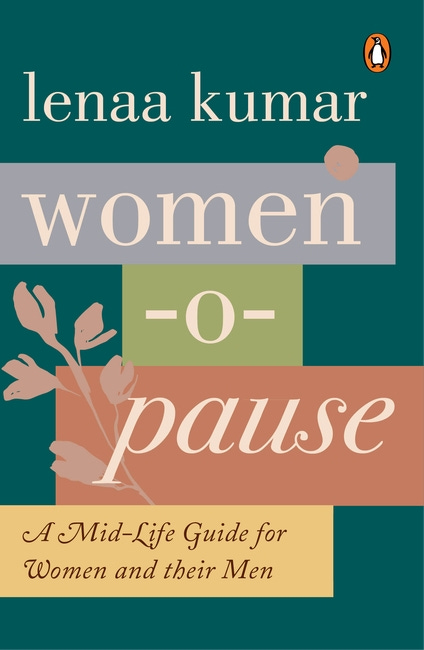
India: Malayam actor/writer Lenaa Kumar is also drawing men into the conversation with her new book Women-O-Pause: A midlife guide for women and their men. Like many of us, Kumar initially viewed this transition as the end, slowly adjusting her belief system over time. She went through the transition early and painfully, starting at 43, and was ultimately helped by functional medicine. I love her analogy here: “During this time, a woman will go through physical discomfort and emotional troubles; it is like shifting homes. The process is chaotic, but once you are settled in your new home, you forget the hassles.”
Editor’s note
I’m on vacation (I hope you are too) and pre-wrote this to go out while I am drinking a beer and staring out into the vast Lake Huron horizon. I hope you are getting a break too. Thank you for being here.
AMx
» If you order any of the products listed in this email, Hotflash inc may receive a commission. Check products to ensure they ship to your region.
» This newsletter is for educational purposes only and not to be used or considered as medical advice.

The 'inert with age' assumption shows up in movement advice too. So much guidance for women over fifty still assumes the body has stopped adapting, when both practice and a growing body of research suggest otherwise.